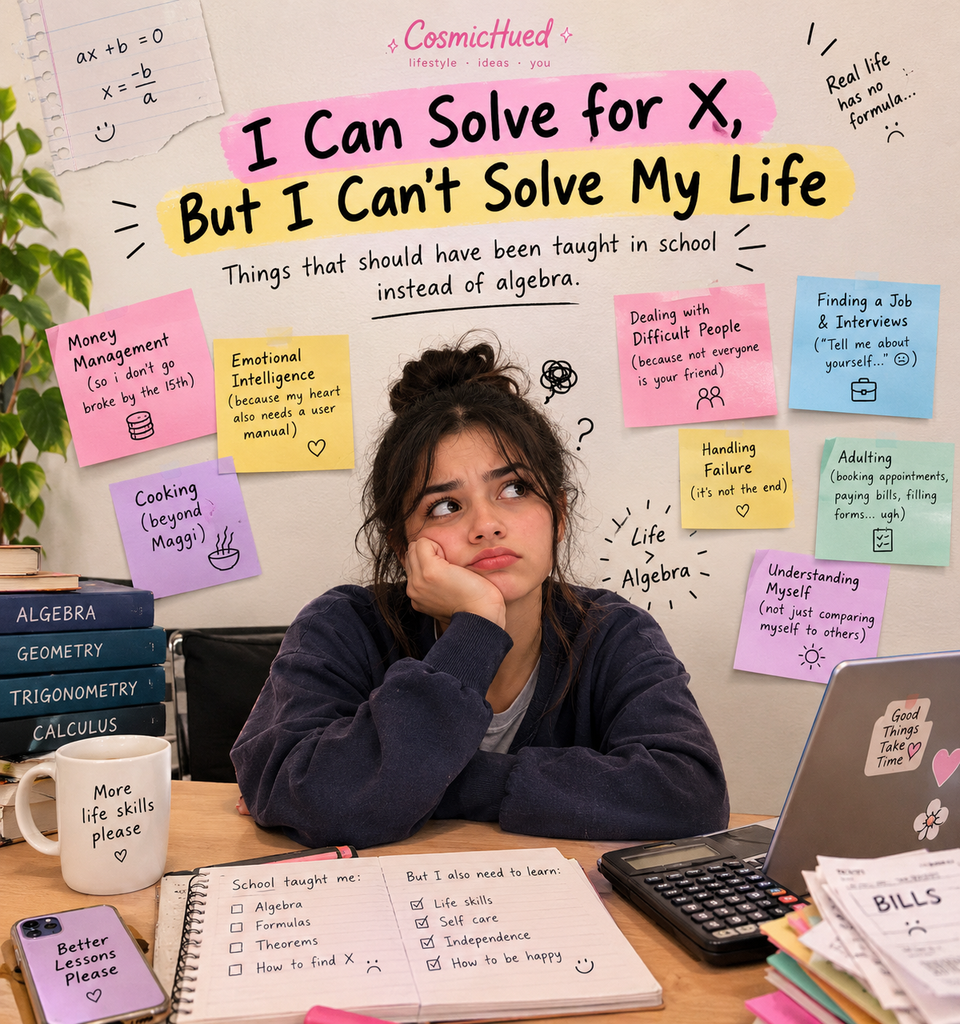
Things that should have been taught in school are probably a list most of us could create after spending a few months in the real world. Remember solving algebra equations, memorising formulas, and calculating the value of X? We spent years learning these things, but nobody really prepared us for the moment we would have to manage our money, cook a proper meal, write a professional email, or deal with adult responsibilities.
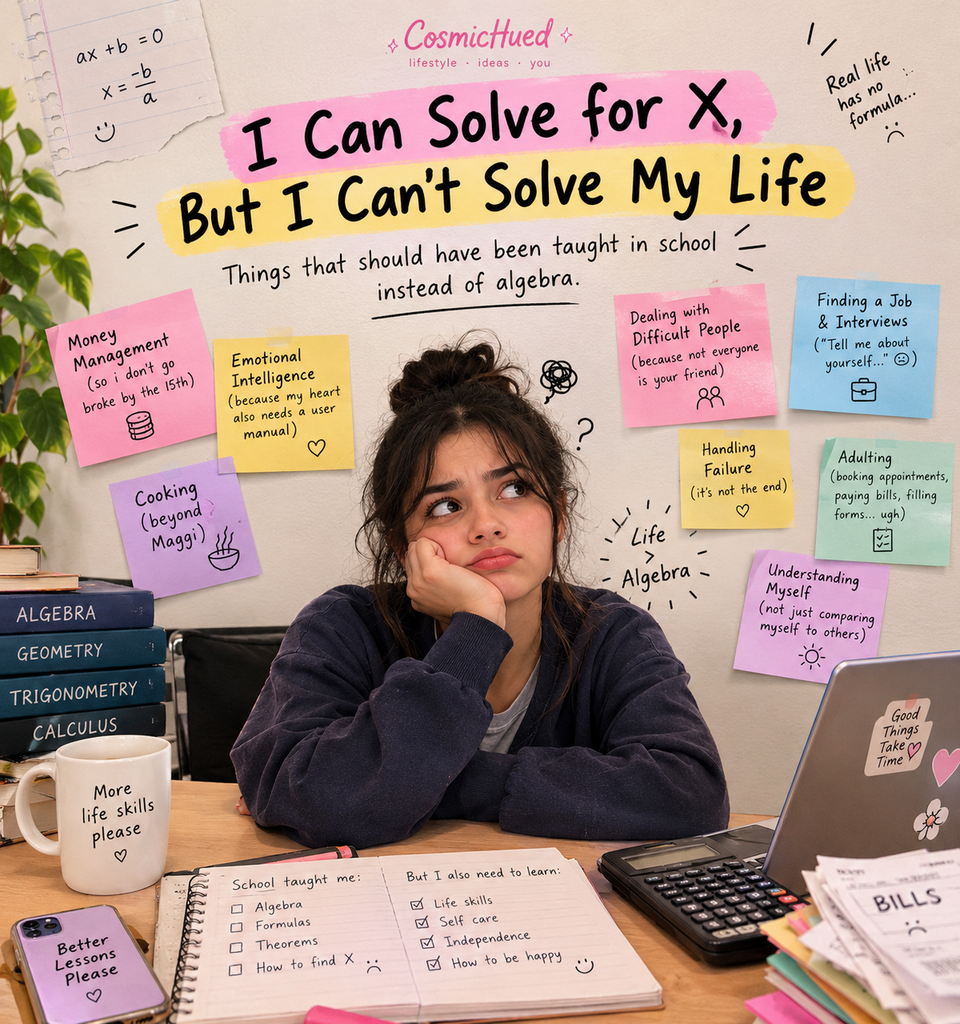
Table of Contents
Let’s be honest: how many times have you searched Google for something that feels like every adult should already know? From understanding bank statements to handling difficult people, adulthood comes with a never-ending list of questions.
Don’t get us wrong. Maths, science, and other academic subjects are important. But education should prepare us for more than exams. It should also teach us the everyday skills we need to become independent, confident, and responsible adults.
So, here are eight things that should have been one of the important things that should have been taught in school instead of making us wonder when we would ever use another algebra formula.
1. Money Management: How Not to Go Broke
If there’s one thing we wish schools had taught us, it’s how to manage money.
Imagine learning how to create a monthly budget, save money, understand taxes, and use a bank account before receiving your first salary. Instead, many of us learn these things through trial and error.
You receive your salary or pocket money, buy a few cute things, order food, pay for subscriptions, and suddenly your bank balance looks like a warning sign.
Schools should teach students about budgeting, savings, interest rates, credit cards, and financial planning. Understanding the difference between needs and wants can also help us make smarter spending decisions.
Financial literacy isn’t just for business students. It’s a life skill everyone needs. After all, knowing how to solve for X is great, but knowing where your money went by the fifteenth of the month is even more useful.
2. Emotional Intelligence: Understanding Our Feelings
We learned about the human heart in biology, but nobody really taught us what to do when our own hearts felt heavy.
Growing up comes with anxiety, stress, rejection, friendship problems, and the pressure to figure out our future. Yet, many of us never learn how to recognise our emotions or communicate what we feel.
Schools should include lessons on emotional intelligence, healthy communication, stress management, and self-awareness. Students should understand that asking for help isn’t weakness and that taking a break doesn’t make someone lazy.
And let’s not forget overthinking. Sometimes, a person replies with just “Okay,” and suddenly our brain starts producing an entire drama series.
Learning to manage our emotions could help us build healthier relationships, make better decisions, and handle difficult situations with greater confidence. And it’s very important to understand how to love yourself, which has obviously not been taught in school.
3. Cooking: More Than Just Making Maggi
One of the funniest parts of becoming an adult is realising that you actually need to feed yourself every single day.
You might know the entire periodic table, but that doesn’t mean you know how to cook rice without turning it into a science experiment.
Basic cooking should be an essential life skill. Schools could teach students how to prepare simple meals, plan groceries, understand food labels, and store food safely.
You don’t need to become a professional chef. Learning to prepare a few healthy, affordable meals can save money and make everyday life easier.
Because eventually, ordering food from Zomato, Swiggy, or any other online food delivery partner every day becomes expensive, and your bank account starts suggesting that you discover your inner chef.
4. Relationships and Boundaries: Learning When to Say No
School teaches us how to solve academic problems, but real-life problems often come with complicated personalities.
There’s the friend who only contacts you when they need something, the person who never respects your time, and the colleague who somehow makes everything your responsibility.
Wouldn’t it have been useful to learn how to set boundaries, communicate honestly, resolve disagreements, and recognise unhealthy behaviour?
Many of us grow up believing that being nice means always saying yes. But healthy relationships require respect, honesty, and the ability to say no without feeling guilty.
Learning about boundaries can help us protect our time, energy, and peace of mind.
Sometimes, the best solution to a problem isn’t another explanation. It’s simply knowing when to walk away.
5. Job Skills: How to Survive the Professional World
Remember how we spent years preparing for exams? Then came the interview question: “Tell me about yourself.”
Suddenly, explaining who we are becomes harder than writing a ten-mark answer.
Schools should teach practical career skills, including writing a CV, preparing for interviews, sending professional emails, communicating confidently, and working in a team.
Students should also learn how to identify genuine job opportunities, recognise suspicious offers, and understand basic workplace expectations.
These skills are especially important when transitioning from education to employment. Knowing how to present your skills and communicate professionally can make a real difference.
And honestly, we could all use a lesson on writing polite emails without turning a simple two-line message into a five-paragraph essay.
6. Dealing With Failure: Life Doesn’t Always Follow the Answer Key
For years, many of us measured success through marks, ranks, and report cards. A good result meant celebration, while a disappointing one could feel like the end of the world.
But real life doesn’t follow an answer key.
Sometimes, you work hard and still don’t get the opportunity you wanted. Sometimes, you choose the wrong course, make a mistake, or watch everyone around you move forward while you’re still figuring things out.
Schools should teach students that failure is part of learning, not proof that they’re incapable.
One exam cannot measure your entire intelligence, and one rejection cannot decide your future. Learning to accept mistakes, ask for feedback, and try again can help us become more resilient.
Sometimes, what feels like a terrible ending is simply a plot twist.
7. Everyday Adulting: The Things We Google at Midnight
Welcome to adulthood, where you can make important decisions but still need Google to explain how to fill out a form.
Nobody really prepares us for booking appointments, understanding basic documents, paying bills, managing household responsibilities, or dealing with official websites.
These everyday tasks may seem simple, but they can become stressful when nobody has explained how they work.
Schools could introduce practical lessons on personal documents, digital safety, basic consumer rights, household management, and everyday problem-solving.
The goal wouldn’t be to teach students every possible answer. It would be to help them become independent enough to find reliable information and make informed decisions.
Because adulthood is basically a never-ending tutorial, and half the time, we don’t even know what to type into the search bar.
8. Self-Confidence: Stop Comparing Your Life With Everyone Else’s
Perhaps one of the most important things that should have been taught in school is how to understand ourselves without constantly comparing our lives to others.
Social media can make it seem like everyone our age is travelling abroad, earning lots of money, building successful businesses, and living their dream life.
Meanwhile, we’re celebrating because we finally cleaned our room.
Everyone has a different timeline. Some people discover their passion early, while others need time to explore different interests. Some know exactly what they want, and others change direction several times.
Schools should encourage students to discover their strengths, explore their interests, and make decisions based on their own goals rather than outside pressure.
It’s okay to change your mind, take a different path, or move at your own pace. Life isn’t a race, even if LinkedIn occasionally makes it feel like one.
Final Thoughts: Maybe We Needed More Life Lessons
Looking back, school gave us knowledge, discipline, and important academic foundations. But education should also prepare us for the world outside the classroom.
Imagine learning about money management, emotional intelligence, cooking, relationships, career planning, and everyday responsibilities alongside traditional subjects.
We might still struggle with adulthood, but at least we’d have a few more tools to handle it.
The truth is, we won’t always need to find the value of X as we were taught in school, but we will need to understand our bank statements, manage our emotions, write professional emails, and figure out what to cook when the fridge is almost empty.
So, we’re not asking schools to remove algebra from the syllabus. We’re simply asking for a little more life in our life lessons.
And if anyone knows how to calculate the emotional damage caused by surprise exams, please show your working!
For more such intresting content or if you want to share your thoughts here please dm us or stay aligned with www.cosmichued.com.
Your budddy
Arshita <3